 ultimate-guide
Can One Clinic Treat Your Whole Family?
Last Updated: October 26, 2026
Quick Summary
Yes, one clinic can treat your whole family, and Plains Road West Medical Clinic does exactly that for households across Burlington. Every family member becomes a patient of the clinic rather than of a single doctor, so children, parents, and grandparents can all be seen under one roof.
- Each family member becomes an individual patient with their own chart at the clinic.
- Complete one intake form per person, including children, with a guardian signing for minors.
- Bring provincial health coverage details for each family member, since each person has their own card.
- A family doctor suits ongoing care, while a walk-in clinic covers sudden illness and prescription renewals.
- Ask the clinic how it handles privacy and requests from one family member about another.
Table of Contents
- Can One Clinic Treat Your Whole Family?
- How to Register Multiple Family Members at One Clinic
- Family Doctor vs. Walk-In Clinic: Which Fits Your Family
- Primary Care Doctor vs. Family Doctor: What the Difference Means for Your Household
- Pediatric Care at a Family Clinic: Children, Teens, and Adults Under One Roof
- When to See a Specialist Instead of Your Family Doctor
- Benefits and Limits of Family-Wide Care
- Book a Visit for Your Whole Household
- Frequently Asked Questions
Can One Clinic Treat Your Whole Family?
Yes, one clinic can treat your whole family, and Plains Road West Medical Clinic does exactly that for households across Burlington. Every family member becomes a patient of the clinic rather than of a single doctor, so children, parents, and grandparents can all be seen under one roof.
The convenience argument is well known. A [2011 analysis in Canadian Family Physician | https://pmc.ncbi.nlm.nih.gov/articles/PMC3076458/] noted that treating an entire family at one practice is often praised for exactly that reason, while cautioning that the time saved may come at a cost to someone in the family.
Below, we explain how family-wide care actually works, how to register multiple people, and when a specialist is the better call.
How to Register Multiple Family Members at One Clinic
Registration is straightforward in principle, but the details decide whether it goes smoothly. Each family member becomes an individual patient with their own chart, and the clinic assigns a primary care provider based on age, need, and availability.
Here is the sequence clinics generally walk families through, with the specifics that trip people up:
- Confirm the clinic is accepting new patients before you gather documents. Rosters fill at different rates for adults, children, and seniors. Ask specifically whether the clinic has room for each age group in your household, not just whether it is "taking patients."
- Complete one intake form per person, including children. A parent or guardian signs for minors. Teens may be asked to complete a confidential portion of the form, because consent and privacy rules change as a child matures.
- Bring provincial health coverage details for each family member. In provinces with a health card, each person has their own card and number. Confirm that the card is current and that the name matches the one on file, since a mismatch can delay a first visit.
- List current medications, allergies, and any specialist referrals in progress. For children, include immunization records and any developmental notes. For seniors, include a current medication list, ideally from the pharmacy.
- Request that records be linked so the household history is visible to every provider. Ask how the clinic handles shared versus separate charts, and who can see what. A linked record is not the same as a shared login; good clinics explain the difference.
A common mistake is registering only the adults and assuming children can be added later. Pediatric spots fill faster than adult ones, and some clinics cap the number of young patients per physician. If you are unsure whether a clinic has room, read whether a family doctor is accepting new patients before you start the paperwork.
Coverage and billing vary by province and by service. Public health coverage generally pays for medically necessary visits, but some services, such as certain forms, notes, or non-insured procedures, may carry a fee (How publicly funded health care coverage works). Ask the clinic for its fee schedule in writing before you register, and confirm whether any family member has coverage through a private plan, an employer, or a federal program for which they may be eligible. The clinic's reception team can tell you what to bring, but the final word on coverage comes from your provincial health plan.
Family Doctor vs. Walk-In Clinic: Which Fits Your Family
A family doctor is the better fit for ongoing care, while a walk-in clinic covers acute medical needs when your regular provider is unavailable. Families usually need both, and the strongest setup is a clinic that offers continuity of care and walk-in access in the same building.
Walk-in care handles sudden illness: a fever that spikes overnight, a sprained ankle, a prescription that ran out. If you are weighing the two, our comparison of family care versus specialized clinics breaks down which model suits different households.
Wait times matter too. Local walk-in clinic wait times vary considerably by time of day, and mornings are generally calmer than evenings.
| Situation | Best Option | Why |
|---|---|---|
| Ongoing condition (diabetes, hypertension) | Family doctor | Continuity of care and tracked history |
| Sudden fever or minor injury | Walk-in clinic | Same-day access, no appointment needed |
| Routine checkup or preventive care | Family doctor | Scheduled screening and follow-up |
| Prescription renewal, provider away | Walk-in clinic | Quick bridge until your doctor returns |
| New symptom needing investigation | Family doctor first | Referral and care coordination |
Primary Care Doctor vs. Family Doctor: What the Difference Means for Your Household
The terms overlap heavily. A primary care provider is any clinician who acts as your first point of contact for health concerns, which can include a family physician or a nurse practitioner (Primary care).
For your household, the practical difference is scope. A family physician manages preventive care, chronic conditions, and referrals, and can treat every generation in your home. A nurse practitioner working in primary care handles much of the same ground, often with more appointment availability.
What matters more than the label is whether the clinic coordinates care. Ask directly: who reads the chart when a different provider sees my teenager? If the answer is vague, keep looking.
Pediatric Care at a Family Clinic: Children, Teens, and Adults Under One Roof
Children, teens, and adults can all receive care at a family clinic, and the arrangement removes the logistics of driving to separate practices. Pediatric care at a family clinic covers newborn checks, developmental milestones, vaccinations, and adolescent health concerns alongside adult appointments.
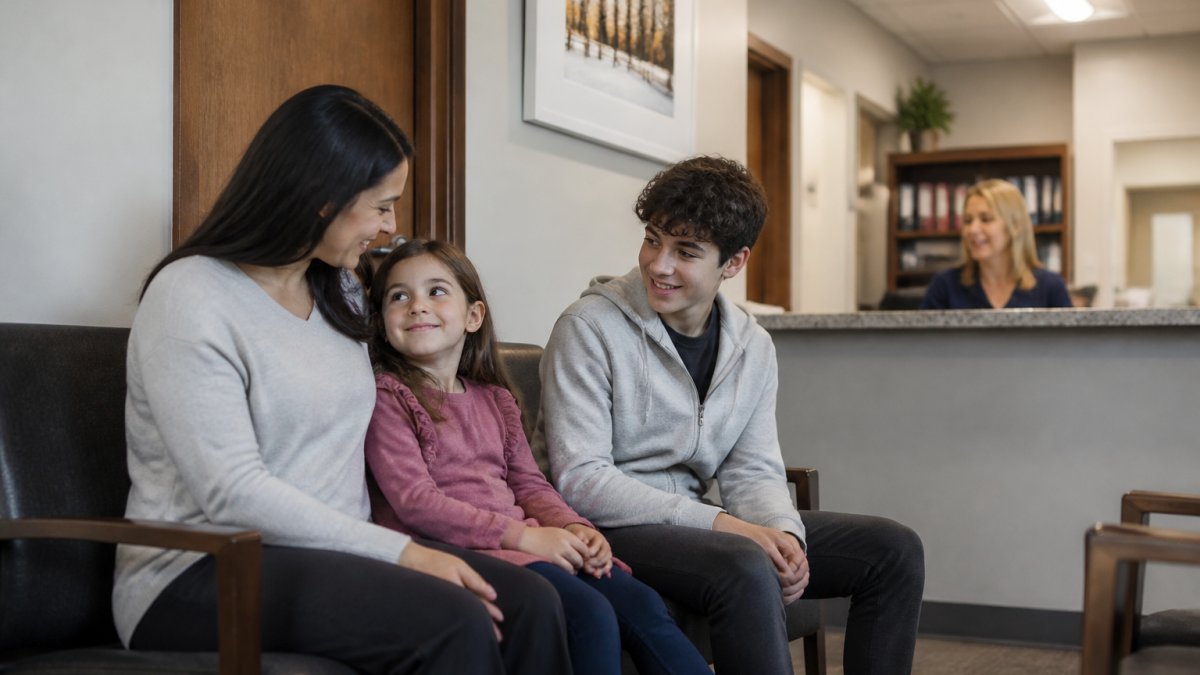
One honest limitation: not every family physician is equally comfortable with every age group. For a deeper look at how shared appointments work across age groups, read our guide to pediatric and adult care in one clinic.
When to See a Specialist Instead of Your Family Doctor
See a specialist when your concern needs expertise, equipment, or procedures your family doctor does not have. A family physician handles the majority of health concerns and issues referrals when a condition requires focused assessment.
Typical referral triggers include:
- Symptoms that have not resolved after standard treatment
- Conditions needing diagnostic imaging beyond basic tests
- Suspected cardiac, neurological, or endocrine disease
- Pregnancy care requiring obstetric involvement
- Mental health needs beyond primary care support
The referral is not a handoff. Your family doctor remains the coordinator, receiving consult notes and following up. That loop is where care coordination earns its keep, and it is the reason a clinic that knows your whole household can catch patterns a series of disconnected visits would miss.
Benefits and Limits of Family-Wide Care
The benefits are real: shared medical records, fewer duplicate forms, one place to call, and a provider who understands how a household's health fits together.
The limits deserve equal weight, and this is where most guides stay quiet.
Privacy within a family. Each patient has their own confidential relationship with the clinic.
Provider capacity. A clinic that accepts a whole household must have room for the whole household.
Differing medical needs. A household may include a newborn, a teenager, a parent with a chronic condition, and a grandparent on multiple medications.
Time and access trade-offs. Family-wide care can save travel and paperwork, but it can also concentrate demand.
A balanced view is that family-wide care works best when the clinic is explicit about privacy, capacity, and scope, and when the household is willing to ask direct questions before registering. If the answers are vague, keep looking.
Book a Visit for Your Whole Household
Our team at Plains Road West Medical Clinic provides family medicine, walk-in services, and preventive care for all ages, with pediatric care from newborn to adolescent health, personalized care for women through every phase of life, and confidential men's health support.
Review our full range of services to see what fits your household, then call to confirm new-patient availability before you arrive.
Frequently Asked Questions
Can one clinic treat the whole family?
Yes, in most cases. A family practice can register each member as a separate patient, so children, teens, adults, and older relatives all receive care at the same location. Each person keeps their own medical record and their own clinician-patient relationship. The main caveat is capacity: a clinic can only take on a household if every member is accepted as a new patient. Ask about new-patient intake for each person before you assume the whole family is covered.
Can you go to a walk-in clinic if you have a family doctor?
You can, and it is common for urgent, same-day problems. Walk-in care suits acute medical needs like a sudden infection, a minor injury, or a prescription renewal when your regular doctor is unavailable. For ongoing concerns, continuity of care matters more: your family doctor holds your patient history and can coordinate follow-up care. If you do use walk-in care, tell the clinic who your regular provider is so the visit can be shared with your record.
What is the difference between a primary care doctor and a family doctor?
The terms overlap heavily. A family doctor is a primary care provider trained to care for patients across all ages and stages, often including pediatric care at a family clinic and general wellness for adults. A primary care doctor is the broader label for the first point of contact in the health system, which can include family physicians, nurse practitioners, and other clinicians. In practice, when you register with a family doctor, you are registering with your primary care provider.
Can a family doctor treat children and adults?
Yes. Family physicians are trained to provide pediatric care at a family clinic alongside adult care, covering routine checkups, vaccinations, growth and development concerns, and common childhood illnesses. A single clinic can therefore see a newborn, a teenager, and both parents. For complex pediatric issues, your family doctor can arrange a referral to a pediatrician while staying involved in follow-up care and care coordination.
When should you see a specialist instead of a family doctor?
See a specialist when a condition needs expertise, equipment, or treatment your family doctor cannot provide, such as a suspected heart issue, a complex chronic condition that is not responding to treatment, or a procedure requiring a specialist's scope of practice. In most cases you reach a specialist through a referral from your primary care provider, who sends your patient history and reason for the request. Your family doctor usually remains your point of contact for follow-up care afterward.
How do you register multiple family members at one clinic?
Contact the clinic and ask whether it is accepting new patients for each member of your household. Expect a new-patient intake process: health card details, a brief health history, medication lists, and any records you can bring from a previous provider. Registering everyone at once helps the clinic coordinate appointments and keep family health needs visible. Confirm each person is formally accepted before cancelling care elsewhere, since registration is confirmed per patient, not per household.
Finding one clinic that can see your toddler, your teenager, and your aging parent without three sets of paperwork is not a small thing. Plains Road West Medical Clinic offers walk-in services for patients of all ages, comprehensive family care, and a medical team focused on patient-centered relationships. Get started with Plains Road West Medical Clinic and give your whole household one place to turn for care.